

Rolling the Dice on Team Building

# Team Collaboration
# Scrum Master/Team Coach (SM/TC)
# Scrum Master
# RTE
# PI Planning
# Peer Learning
# Leadership and Culture
# Innovation
# Facilitation
# AI
# Agile Release Train (ART)
Bringing Some Adventure to PI Planning
September 22, 2026
Rick Wood
As a Release Train Engineer, I spend a lot of time thinking about how to bring people together. We have ceremonies, planning sessions, retrospectives, and plenty of tools designed to help teams collaborate. But sometimes the things that bring a team closer have very little to do with a framework or process.
For me, one of those things has unexpectedly been Dungeons & Dragons.
I should start by saying that I am not an experienced D&D player. Before these experiences, D&D certainly wasn't something I would have thought of as a tool for team building. That may actually be part of why it worked so well. It was different, unexpected, and something many of us could experience for the first time together.
Bringing Some Adventure to PI Planning
PI Planning (Program Increment Planning) is an important event, but it is also a long one. Teams spend hours discussing priorities, capacity, dependencies, risks, and objectives. While all of that work is necessary, I am always looking for small ways to make the experience more engaging and memorable.
Before one of our PI Planning events, our Value Stream Lead suggested creating personalized Dungeons & Dragons-style character cards for the team. I thought it was a great idea and decided to see what I could do with it.
Using team members' headshots as a reference, I created a fantasy character for each person and incorporated the images into personalized cards with a character class, attributes, signature abilities, and other details inspired by their personality or role on the team.
The cards weren't part of an exercise. There was no required activity associated with them and no lesson attached. They were simply something fun that I could hand out during PI Planning.
That simplicity turned out to be part of what made them successful.
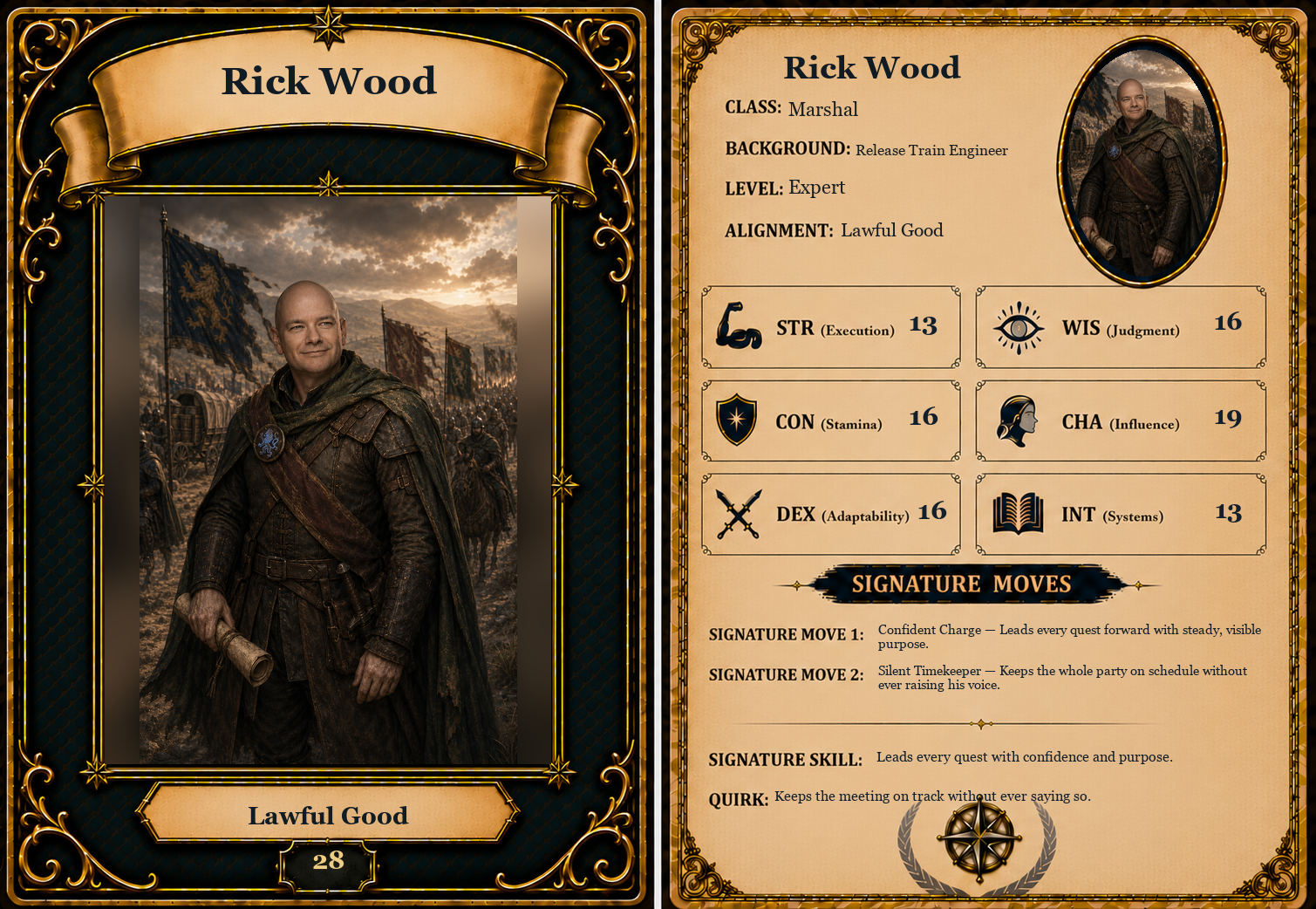
People immediately started comparing cards, looking at each other's characters, laughing about their abilities, and walking around to see what everyone else had received. People who might not normally interact during the event suddenly had an easy reason to start a conversation.
The cards also gave everyone something tangible to take away from PI Planning. Instead of another document or presentation, they had something they could put on their desk, show someone else, and associate with the experience.
Experiencing D&D as a Team
The cards were not my first experience with Dungeons & Dragons as a way to bring coworkers together.
About a year earlier, we held a separate team-building event where we hired a professional Dungeon Master to introduce us to the game and guide us through a couple of short adventures over the course of a few hours.
For many of us, myself included, it was our first real experience playing D&D.
Nobody needed to be an expert. We were learning together, figuring out what our characters could do, making decisions, solving problems, and laughing when our plans inevitably went in directions nobody expected.
D&D naturally creates situations where people have to communicate and collaborate. Everyone brings different abilities to the group, and success usually comes from figuring out how those abilities can work together. At the same time, the game leaves plenty of room for creativity, humor, and individual personalities to come through.
Most importantly, it was accessible. Having an experienced Dungeon Master handle the complexity and guide us through the game meant that even a group of mostly inexperienced players could participate and enjoy the experience.
A year later, people still talk about that event. For me, that may be the best measure of whether a team-building activity worked.
Shared Experiences Matter
Neither experience was intended to teach a formal lesson about Agile or SAFe. What they did was create shared experiences: the D&D session put people into an unfamiliar environment where they could solve problems, experiment, laugh, and succeed together, and the character cards brought some of that same spirit into PI Planning by giving people an unexpected reason to interact with coworkers outside their normal conversations.
There is also something valuable about the fact that none of us needed to be D&D experts for any of this to work. I certainly wasn't. The game was simply a vehicle for creating interaction, and the cards were a creative way to bring some of that experience into another setting.
As RTEs and leaders, we spend a great deal of time creating the conditions that allow teams to work effectively. Processes and practices are important, but relationships matter too. People collaborate differently when they know each other, are comfortable talking to one another, and have shared experiences beyond their normal work.
Dungeons & Dragons may not be the first thing that comes to mind when thinking about Agile teams, but my experiences with it have shown me how effective something unexpected can be at bringing people together. Whether it is sitting around a table navigating an adventure together or discovering that your coworker has been transformed into a wizard, ranger, bard, or paladin, D&D creates opportunities for conversation, laughter, collaboration, and shared memories. Team building doesn't always need to be complicated, and it certainly doesn't need to feel like another meeting — sometimes it can start with rolling a twenty-sided die.
Comments (0)
Popular

Dive in